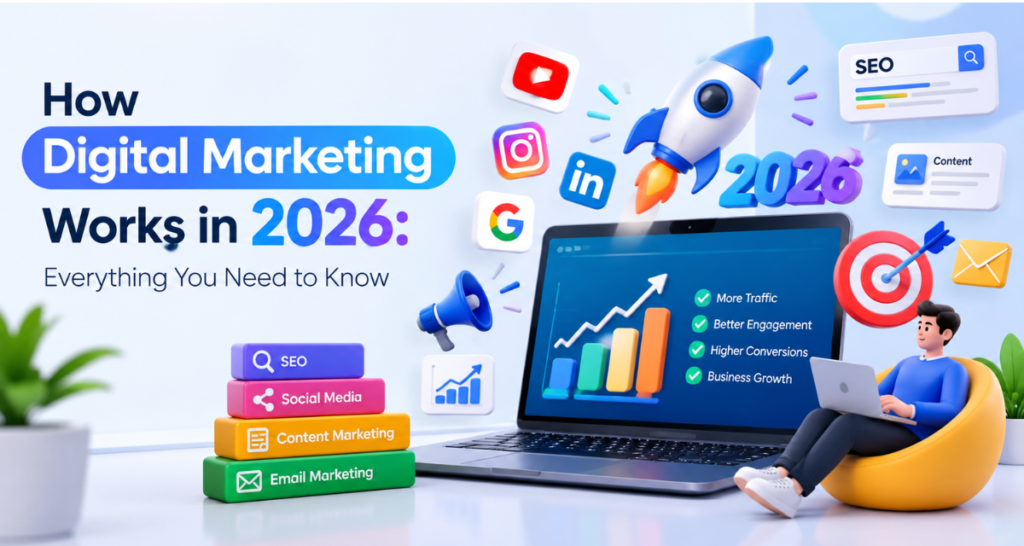
Digital marketing is more than posting on Instagram, running Google Ads, or creating a website. It is a complete process that helps businesses attract the right audience, build trust, generate leads, and turn potential customers into paying customers.
But how digital marketing works can seem confusing when there are so many channels and strategies involved. The simple answer is that digital marketing connects the right message with the right audience through the right online channel and continuously improves the results using data.
In this guide, you will learn the complete digital marketing process, how different channels work together, how agencies operate, and how businesses measure success.
What Is Digital Marketing and How It Works
Digital marketing refers to promoting a business, product, or service through digital channels such as search engines, websites, social media, email, and online advertising.
When someone searches for a product on Google, watches a brand’s video on social media, visits a website, or clicks an online advertisement, they are interacting with digital marketing.
Understanding what is digital marketing and how it works becomes easier when you look at it as a customer journey:
Attract → Engage → Build Trust → Convert → Retain → Measure → Improve
For example, a potential customer might discover a business through Google, read a helpful blog, visit its website, follow its social media account, and eventually contact the business.
How Digital Marketing Works Step by Step

Understanding how digital marketing works requires looking at the process from beginning to end.
1. Identify the Target Audience
The first step is understanding who you want to reach.
Businesses research factors such as:
- Customer needs and problems
- Interests and preferences
- Search behavior
- Location
- Buying intent
- Demographics
- Online habits
A clear understanding of the target audience helps businesses create relevant messages instead of trying to reach everyone.
2. Build a Strong Online Presence
Once the audience is clear, the business needs a place where people can learn more about it.
This may include:
- A professional website
- Google Business presence
- Social media profiles
- Helpful content
- Landing pages
- Consistent branding
Your website often acts as the central destination where visitors can discover your products, services, expertise, and contact information.
3. Attract the Right Audience
The next step is bringing relevant people to your online presence.
Different channels can play different roles:
SEO: Helps businesses appear in relevant search results.
Content marketing: Provides useful information that answers customer questions.
Social media: Helps brands connect with and engage their audience.
Paid advertising: Allows businesses to reach specific audiences through targeted campaigns.
Email marketing: Helps businesses communicate with people who have already shown interest.
The objective isn’t simply to generate traffic. It is to attract relevant traffic that has a genuine possibility of becoming a customer.
4. Engage and Build Trust
Getting someone’s attention is only the beginning.
People usually need information before making a decision. Businesses can build trust through educational content, customer reviews, case studies, useful social media posts, videos, and transparent communication.
This is where how digital marketing works becomes different from simply advertising. Effective digital marketing focuses on the entire relationship with the customer rather than only asking for a sale.
5. Convert Visitors Into Leads or Customers

After building interest and trust, the next goal is conversion.
A conversion could mean:
- Filling out a contact form
- Making a purchase
- Booking a consultation
- Calling a business
- Signing up for an email list
- Sending an enquiry
Clear calls to action, relevant landing pages, strong offers, and an easy user experience can help turn visitors into leads or customers.
6. Retarget and Nurture Potential Customers
Not everyone converts during their first interaction.
Someone might visit a website today but make a decision weeks later. Businesses can continue communicating with interested audiences through appropriate remarketing, email campaigns, content, and follow-up strategies.
The goal is to stay relevant without overwhelming the customer.
7. Measure and Optimize
The final step is measurement.
Businesses can analyze:
- Website traffic
- Leads
- Conversion rate
- Cost per lead
- Customer acquisition cost
- Engagement
- Return on ad spend
- Overall ROI
The data helps marketers understand what is working and what needs improvement.
Digital marketing is therefore not a one-time activity. Campaigns, content, audiences, and landing pages can be tested and improved continuously.
How Different Digital Marketing Channels Work Together
One of the biggest misconceptions about digital marketing is that every channel works independently.
In reality, the strongest strategies often connect multiple channels.
For example:
Google Search → Website → Educational Content → Social Proof → Landing Page → Enquiry
A person may first discover a business through SEO. They might then read a blog post, check the company’s social media, see customer reviews, and eventually contact the business.
This connected approach makes what is digital marketing and how it works much easier to understand. Each channel can support a different stage of the customer journey.
SEO can generate organic visibility, social media can build engagement, content can educate, paid advertising can generate targeted traffic, and a website can convert that traffic into enquiries or sales.
How Digital Marketing Agency Works

Many businesses choose to work with an agency because managing multiple marketing channels requires different skills and consistent execution.
So, how digital marketing agency works is generally based on a structured process:
Discovery → Research → Strategy → Creation → Launch → Measurement → Optimization
First, the agency understands the business, audience, competitors, goals, and existing marketing performance.
Next, it develops a strategy based on those findings. Depending on the business, this may involve SEO, social media, content marketing, paid advertising, email marketing, or a combination of channels.
Different specialists may then work on different parts of the strategy. SEO specialists focus on organic visibility, content teams create useful material, performance marketers manage advertising campaigns, designers develop creative assets, and analytics teams monitor performance.
The agency then reviews the results and makes improvements based on actual data.
Understanding how digital marketing agency works is important because a good agency should not simply produce posts or launch advertisements. It should connect marketing activities to measurable business objectives.
How Businesses Measure Digital Marketing Success

Knowing how digital marketing works is incomplete without understanding measurement.
Different businesses may use different KPIs depending on their objectives.
For brand awareness, businesses may monitor reach, impressions, and engagement.
For lead generation, useful metrics may include leads, conversion rate, cost per lead, and customer acquisition cost.
For e-commerce, businesses may focus on purchases, revenue, conversion rate, average order value, and return on ad spend.
The key is to measure metrics that connect marketing activity with the actual business goal.
Why Digital Marketing Matters in 2026
Digital customer journeys continue to involve multiple online touchpoints. People may discover a brand through search, social media, video, recommendations, advertisements, or online content before making a decision.
In 2026, businesses also need to think about areas such as:
- AI-assisted content and marketing workflows
- Search behavior across different platforms
- Personalization
- Data-driven decision-making
- Short-form video
- Multi-channel customer journeys
- Conversion optimization
However, technology alone does not create a successful strategy. Businesses still need a clear audience, useful messaging, strong creative, relevant offers, and continuous testing.
Final Takeaway
So, how digital marketing works can be summarized in one simple framework:
Find the right audience → attract them → provide value → build trust → encourage action → measure results → optimize continuously.
The most effective digital marketing strategies do not rely on a single channel. They combine different channels around a clear business objective and use data to improve performance over time.
If you want to explore digital marketing strategies and how businesses can grow their online presence, visit The Cognixa.
Frequently Asked Questions
1. How does digital marketing work for beginners?
Digital marketing works by using online channels to attract, engage, convert, and retain customers. Businesses identify their target audience, create relevant content or campaigns, bring visitors to their digital platforms, encourage conversions, and measure the results to improve future marketing activities.
2. What is digital marketing and how does it work?
What is digital marketing and how it works can be understood through the customer journey. Businesses use channels such as SEO, social media, content, email, websites, and paid advertising to reach potential customers, build trust, generate interest, and encourage them to take action
3. How does a digital marketing agency work?
A digital marketing agency typically begins by understanding a client’s business and goals. It researches the audience and market, creates a strategy, executes campaigns, tracks performance, and continuously optimizes the work. How digital marketing agency works can vary depending on the client’s objectives, industry, budget, and chosen channels.
4. How long does digital marketing take to show results?
The timeframe depends on the strategy and channel. Paid advertising can generate traffic quickly, while SEO and content marketing generally require consistent effort and time to build visibility. Results also depend on competition, audience demand, website quality, budget, and execution.
5. Which digital marketing channel is best for a business?
There is no single best channel for every business. The right choice depends on the target audience, business model, objectives, competition, and budget. SEO, social media, content marketing, paid advertising, and email marketing can each play different roles in the customer journey.